
Two Journeys, One Spirit: Village residents share their experiences as pioneers in the Peace Corps

In August 1961, the first group of volunteers to serve the newly formed Peace Corps headed to Africa. In its first year, about 900 answered the call to join the organization.
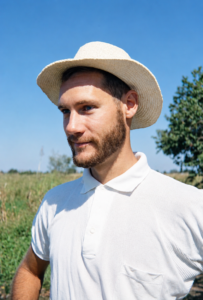
Among that first wave was Village resident Bob Krisko, who served in Ghana.
Ten years later, the Peace Corps launched a pilot initiative that allowed a small number of families with children to serve. Among that first group of family volunteers was Village resident Gretchen Bearce, who arrived in Kenya in 1971 with her husband and children.
As the United States continues to celebrate 250 years as a nation this year, John Knox Village is featuring residents who have unique and inspiring stories about their American experiences. Bob’s and Gretchen’s service in the Peace Corps exemplify many of the traits of the American spirit, including sacrifice, generosity, and taking bold risks.
A Peace Corps Pioneer
For Bob, it started with an article in the local paper. Reading about President John F. Kennedy’s proposal to form a corps of young citizens to serve overseas immediately sparked his interest. He wrote a letter requesting more information and later found himself walking through the doors to take an entrance exam for a program that didn’t even have a proper title yet.
After finding out the test had a six-hour duration, he quickly told the recruiter he’d have to reschedule. Time passed, and he hadn’t completed the entrance exam yet. Nonetheless, he received a telegram…”I’d been selected to go to the Peace Corps,” Bob recalled. “The telegram said I was going to ‘Chana.’ I didn’t have a clue where that was. Maybe they meant China?” He thought. Turns out it was a typo…Bob was about to be on his way to Ghana, a West African country on the Gulf of Guinea. Not long after, he was completing his training at the University of California, Berkeley heading to Washington, D.C., where he and the other volunteers met with the president before their departure. “It really didn’t sink in until then,” Bob said. “We were the first group.”
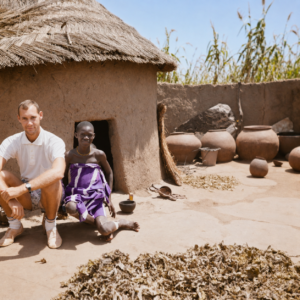
When the first groups departed for Africa, the legislation that permanently created the Peace Corps had yet to pass the Senate. The Peace Corps had been launched by an executive order issued in March 1961, two months after Kennedy’s inauguration. As a part of Peace Corps Ghana I, Bob spent two years teaching math and science, one at a government secondary school and another in one of the country’s most remote regions by the borders of Togo and what’s now known as Burkina Faso.
“They needed someone who could stand being in a location that isolated…and I was the only one that the psychologist in charge said was capable,” he said. While many might find this task daunting, Bob has great memories of his time volunteering. “The whole experience was so good,” he said. “The people were totally friendly. You always felt safe there. They loved Americans!”
Throughout his time in different parts of Africa, he was immersed in new cultures and traditions. “I could speak a little bit of one of their languages if I wanted to go buy a pineapple at the market, or if I needed to find a restroom,” he recalled.
Peace Corps, Family Edition
A decade later, the Bearce family became part of the first wave of Peace Corps families serving abroad. Gretchen’s younger brother and his wife had already served after their college years and returned with some of the most amazing stories. In 1971 and 1972, the Peace Corps ran a brief, experimental “Family Program” that allowed married couples with children to serve overseas as volunteers. Today, Peace Corps volunteers are not permitted to bring anybody with them during their service, including pets. Those with dependent children must submit a signed and notarized letter stating who will care for them during the volunteer’s service.
Gretchen’s family got to stay on a college campus in Kenya, living in a fully furnished duplex, with a live-in maid, and neighbors from all areas of the world. “It doesn’t even sound like the Peace Corps, does it?!” she laughed.
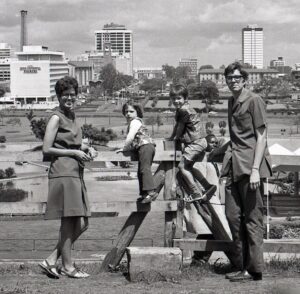
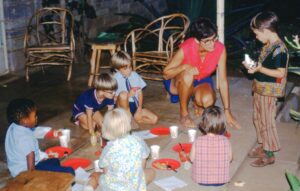
Her kids adapted to the new lifestyle extremely well, as the maid was also their caregiver while their parents were out teaching and taking language classes. Weekends routinely included loading the car up with equipment borrowed from the Peace Corps and exploring some of Kenya’s best game parks with the other volunteer families. The Bearce’s were surrounded by beautiful landscapes and wildlife. “I don’t know very many people, even today, who can say they lived among the animals of Africa!” Gretchen said.
From Strangers to Neighbors
Though their experiences differed, they both discovered a greater appreciation for other cultures and for their home country.
Being in Ghana during the early 1960’s redefined the way Bob sees his own country. “I got a different perspective of America,” he said. “I saw things that made me appreciate it more, but I came to appreciate so many things in Africa too.” Gretchen left with a similar appreciation for cultural understanding. She believes one of the Peace Corps’ greatest strengths is allowing people to know Americans apart from all the headlines they see. “We’re not all like what you see on television,” she said. “We go and live in the community. We become neighbors.”
And equally as important, volunteers return home with a deeper understanding of the countries that welcomed them too. “Those people in Kenya are just like us,” she said. “Under our skin, we’re the same.” The art of mutual learning has always been a key inspiration to the Peace Corps mission. Volunteers get to travel overseas not only to share their skills, but also to learn from the communities they’re in.
Bob still attends monthly Zoom meetings with members of his original Ghana group, over 60 years after they journeyed together. Gretchen still treasures the friendships, memories and family adventures that began in Kenya. “It’s mind-boggling to live in another country as part of their community,” she said. She encourages anyone and everyone with the chance to serve to take the leap.
Their Peace Corps experiences may have begun years apart and on opposite sides of Africa, but they will always share a common lesson: Getting to know communities outside of your own and opening yourself up to new perspectives can make this big world seem a little smaller.